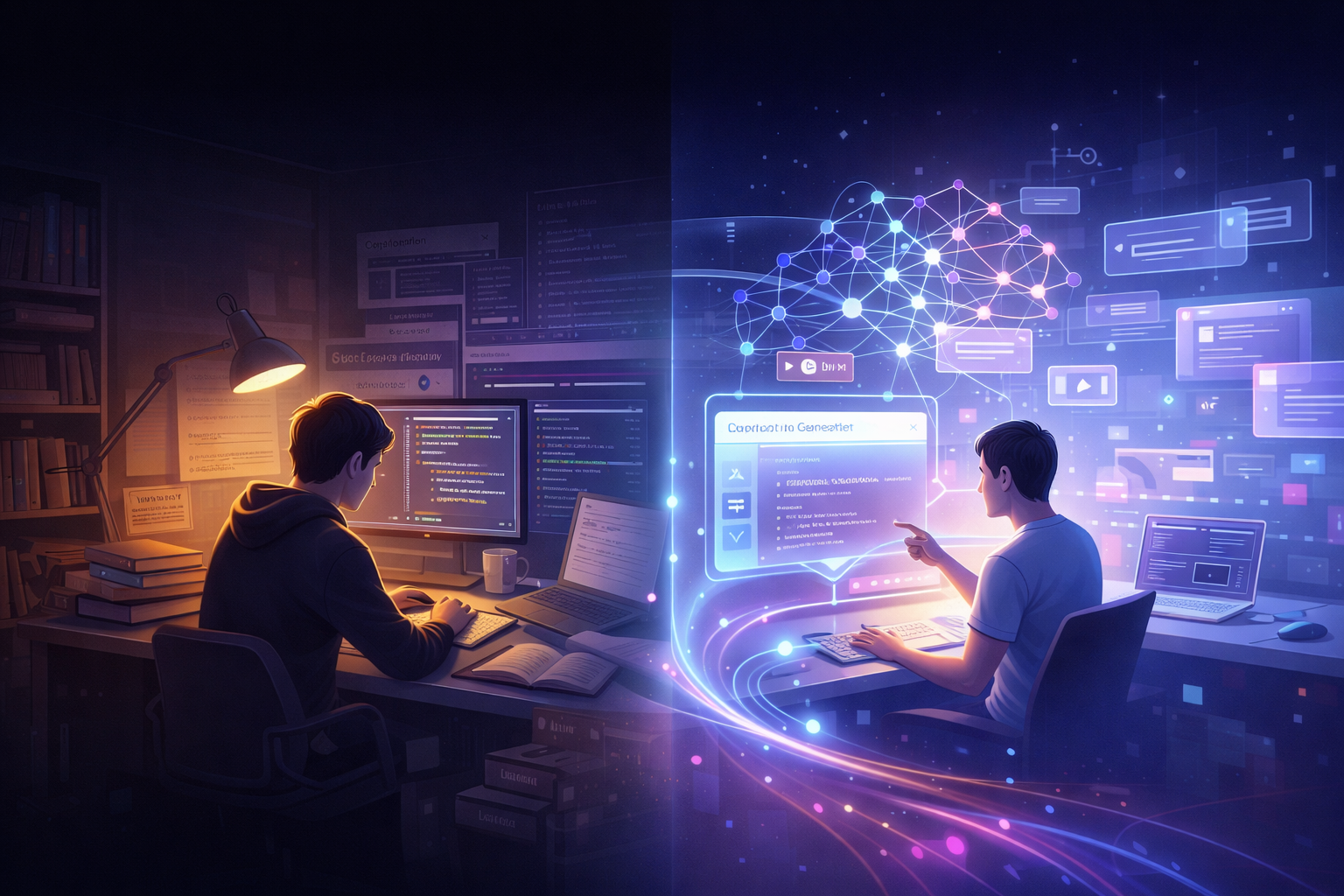

The Evolution of Software Development in the Age of AI
Before 2019, the software development landscape looked very different. Developers relied heavily on documentation, user manuals, and community-driven platforms like forums to learn, troubleshoot, and implement new solutions. Progress often required deep research, experimentation, and collaboration. Writing code was a deliberate process rooted in strong foundational knowledge and experience. Today, we are living in a fundamentally transformed era. With the rise of Artificial Intelligence, particularly Large Language Models (LLMs), the dynamics of software development have shifted dramatically. Developers can now generate user interfaces, write code, design APIs, and even build full applications with a single prompt. What once took days or weeks can now be achieved in minutes.
The Power and Promise of AI in Development
AI-powered tools are revolutionizing how developers work. They assist with:
- Automated code generation
- Debugging and bug fixing
- Rapid prototyping
- Learning new frameworks and technologies
According to a 2023 survey by Stack Overflow, 29,697 out of 67,237 professional developers reported using AI tools in their workflows. Additionally, 2,722 out of 4,961 learners indicated that they use AI tools to learn programming.
This data highlights a clear trend: AI is not just a tool for experienced developers—it is becoming an entry point for beginners as well.
The Critical Question: Who Truly Benefits?
The rise of AI introduces an important question: Who benefits the most from these tools?
At first glance, it appears that novice developers gain the most. With tools like GitHub Copilot and Codex, even beginners can generate functional software by simply writing prompts. This lowers the barrier to entry and accelerates learning.
However, the reality is more nuanced.
AI does not replace experience—it amplifies it.
Experienced developers bring something that AI cannot replicate:
- Architectural thinking
- Problem decomposition
- Critical evaluation of solutions
- Understanding of scalability and maintainability
While AI can generate code, it lacks true contextual understanding of long-term system design. Without foundational knowledge, developers may produce solutions that appear correct but are inefficient, insecure, or difficult to maintain.
The Hidden Risks of Over-Reliance on AI
Relying too heavily on AI can introduce several risks:
- Erosion of core programming skills
- Reduced understanding of system architecture
- Increased debugging time due to poorly generated code
- Higher likelihood of non-standard or fragile solutions
In many cases, developers without strong fundamentals may spend more time fixing AI-generated code than writing it themselves.
The Ideal Balance: Foundation + AI
The most effective approach is not choosing between AI and traditional learning—it’s combining both.
Developers who possess strong foundational knowledge and leverage AI tools can:
- Write higher-quality code
- Build scalable and maintainable systems
- Accelerate development cycles
- Deliver market-ready products faster
AI becomes a force multiplier, not a replacement.
Final Thoughts
We are witnessing a paradigm shift in software development. AI is redefining productivity, accessibility, and innovation in the industry. However, the core principles of software engineering remain unchanged.
The future belongs to developers who can think critically, design intelligently, and use AI strategically.
Because in the end, AI can write code—but only skilled developers can turn it into meaningful, reliable, and impactful software.